Product Changes
A requested product modification MUST NOT silently modify the current model, and it does not directly become a backlog item. It becomes a Product Change: an explicit, validated delta against the baseline that records the meaning, rationale, scope and affected artifacts of the change.
A Product Change is not a pull request, a delivery container or an implementation state. A pull request is the human review and acceptance boundary for a Product Change; it is not the change itself. Decomposing, scheduling and implementing the work are the concerns of whatever consumes the definition (see the Citation Contract).
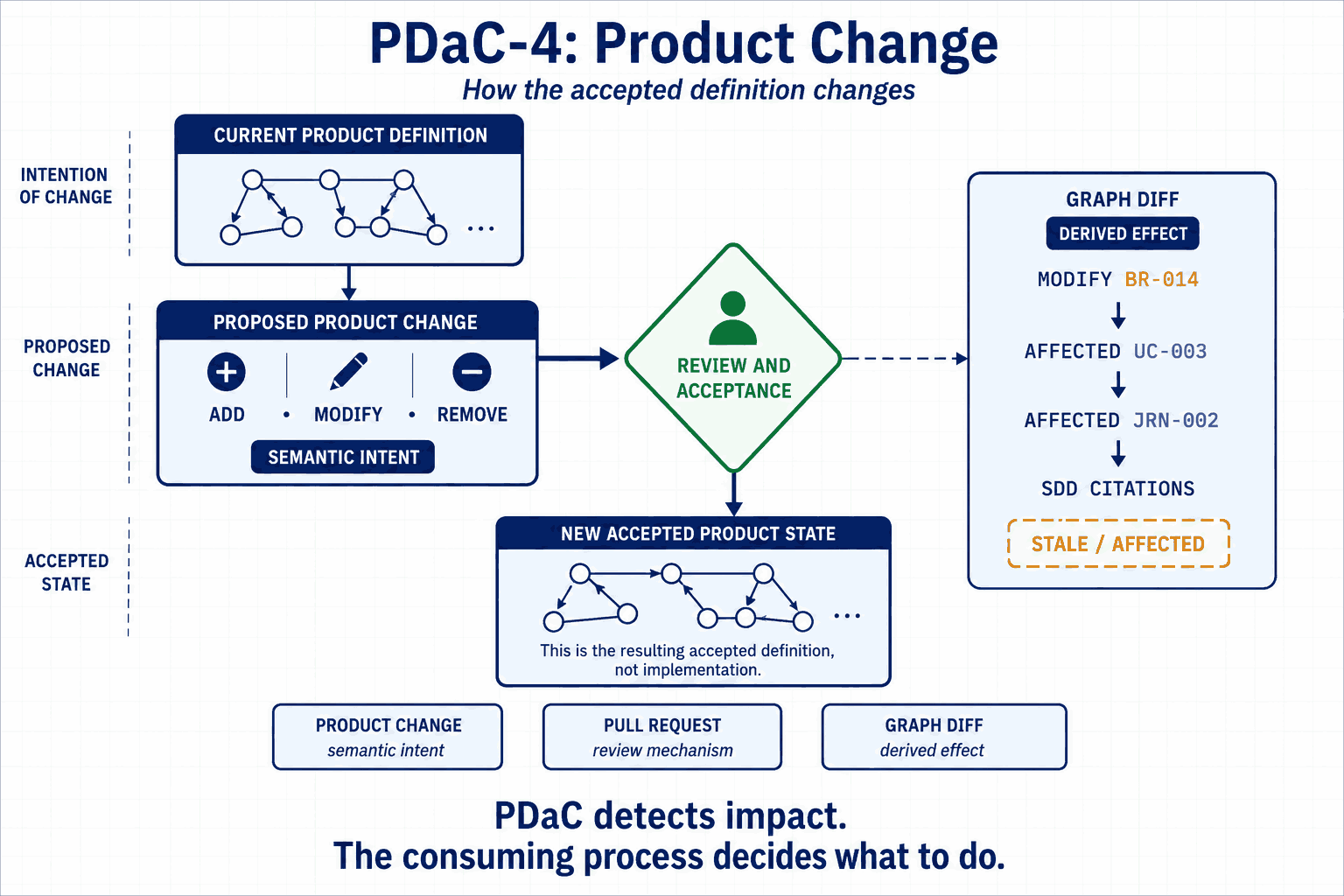
Figure PDaC-4 - how does the accepted definition change? Non-normative; this chapter is authoritative.
Structure
Section titled “Structure”A Product Change lives in its own directory, named by its lowercase ID:
docs/product/changes/active/<chg-id>/├── change.md # canonical change definition└── proposed/ # complete proposed future-state artifacts └── <same layout as docs/product/model>change.md frontmatter contract (schema product-change):
---id: CHG-CITATIONS-001type: product-changetitle: Cite canonical product text instead of restating itstatus: proposedbase-revision: <git-commit-sha> # or '0000000' only for CHG-INITIAL with no baseline commitoperations: add: [BR-CITE-CANONICAL, FR-CITATIONS-001] modify: [UC-VALIDATE-001] remove: []---Required body sections: ## Problem, ## Intended Product Outcome, ## Rationale, ## Affected Product Areas, ## Open Questions, ## Product Acceptance, ## Out of Scope.
Each terminal status has exactly one archive directory: applied changes are archived under docs/product/changes/completed/<chg-id>/, rejected changes under docs/product/changes/rejected/<chg-id>/, and superseded changes under docs/product/changes/superseded/<chg-id>/. An archived change’s directory MUST agree with its status: a change that was approved and then superseded is not a change that was rejected, and the change history is the evidence of which happened. Archived changes are inert history: they are not compiled into the product graph, and their IDs and proposed artifacts take no part in duplicate detection, reference resolution or operation checks.
Elaboration
Section titled “Elaboration”A Product Change is elaborated iteratively while it is draft or proposed: opened with a partial intent, then widened, narrowed, corrected and revised until it is worth proposing for approval. Several Product Changes MAY be active at once.
Implementations SHOULD use the product graph to support elaboration: surfacing the artifacts a proposed operation would affect, the artifacts put in question by those artifacts under the impact polarity of Relationships → Canonical vocabulary, and the open questions the change has not answered. This is assistance, not authority. A tool MUST NOT resolve an open question, invent a product decision or set approved on the author’s behalf (manifesto principles 6 and 7).
Operations
Section titled “Operations”Operation IDs MAY name any Product Artifact, including a Structured Behaviour.
- Every ID in
operations.addMUST NOT exist in the baseline, and MUST have a complete proposed future-state artifact underproposed/. - Every ID in
operations.modifyMUST exist in the baseline, and MUST have a complete proposed future-state artifact underproposed/using the same ID. - Every ID in
operations.removeMUST exist in the baseline. Removed artifacts need no tombstone files. - Every artifact under
proposed/MUST be listed inoperations.addoroperations.modify.
Overlay validation
Section titled “Overlay validation”To validate a Product Change, an implementation MUST compile an overlay - the baseline graph with additions added, modifications replaced and removals deleted, without modifying any baseline file - and then apply full structural validation to the overlay. Overlay-specific errors are enumerated in Validation.
When a dangling reference in the overlay is caused by an ID named in the change’s remove set, an implementation MUST report PRODUCT024 and MUST NOT additionally report PRODUCT006 for the same reference. PRODUCT006 remains the diagnostic for a reference that dangles for any other reason.
While a Product Change is active, the baseline artifacts it touches remain authoritative and unchanged. An implementation MUST check concurrent active Product Changes for overlapping modify/remove sets. For each change, the overlap set is the union of operations.modify and operations.remove; every target present in two or more active changes is an error against each change that names it, including modify/remove and remove/remove intersections. The overlap remains an error until all but one of those changes is rebased or withdrawn.
Lifecycle
Section titled “Lifecycle”productChangeStatus: draft → proposed → approved → applied, with rejected (from draft or proposed) and superseded (from any non-terminal state) as terminal alternatives.
Entering a terminal status archives the change: its directory moves out of active/ into the archive directory for that status (see Structure), and the archived change.md records the terminal status. Archiving is a move, not a copy.
approved is a human product decision: the change is judged correct and wanted. It is what authorizes apply. It says nothing about implementation, and there is no status for implementation: whether the accepted intent has been built is a fact about delivery, not about the change (RFC 0004).
Acceptance is not a status on the change. An applied change enters the accepted Product Definition when a human merges the pull request carrying it (see Terminology → Accepted).
A Product Change in status approved whose ## Open Questions section still contains one or more unresolved questions SHOULD produce exactly one warning (PRODUCT108) against the Product Change. The warning is state-based, not one warning per list item. It is reported whenever the change is validated, not only at the moment the status changes, so that it is reproducible from repository content alone.
For PRODUCT108, an unresolved question is a Markdown list item within the change’s ## Open Questions section, at any nesting depth. A list item counts as unresolved regardless of its content: nothing in the syntax distinguishes an answered item from an open one, and task-list checkboxes are not interpreted. Resolving a question therefore means removing its list item - deleting it, or folding it into the prose that answers it. A section with no list items has no unresolved questions: prose is not a question, so None. and an empty section are resolved by construction. The rule is syntactic on purpose: two implementations reading the same bytes have to agree, and no deterministic tool can judge whether prose contains an open question.
Apply materializes and validates a proposal. It does not accept the change, and it does not by itself modify the accepted Product Definition.
The distinction is a distinction of location, not of file content. docs/product/model on a working branch is a proposal; docs/product/model on the canonical branch is the accepted Product Definition. Apply changes the former. Only a human merging the pull request changes the latter. An implementation that treats a successful apply as acceptance is non-conforming.
Apply:
- MUST require change status
approved. Applying a change in any other status MUST fail withPRODUCT028, leaving the working tree untouched. - MUST revalidate the overlay.
- MUST check baseline-revision compatibility before writing. For
CHG-INITIALcarrying exactly0000000, apply MUST skip Git resolution and baseline drift comparison and MUST NOT emitPRODUCT027because the sentinel does not resolve. Every ordinarybase-revision, including other all-zero strings and0000000on another change, MUST resolve to exactly one commit; failure emits onePRODUCT027againstbase-revisionand leaves the working tree untouched. After resolution, each artifact named inoperations.modifyoroperations.removeis compared by content digest with its content at that commit. Each differing target emitsPRODUCT027and apply fails until the change is explicitly rebased - proposed artifacts regenerated and reviewed,base-revisionupdated, and the overlay revalidated. A commit that touched a file without changing normalized content is not drift.operations.addis not drift-checked: an addition has no baseline artifact to compare, and an ID added since is alreadyPRODUCT020in the revalidated overlay (RFC 0066). - Writes additions, modifications and removals into the working tree’s
docs/product/model, naming files by lowercase ID. - MUST compute the product diff between the baseline and the applied result, and MUST report it in the operation’s output in both a human-readable and a machine-readable form. Each entry names the impacted artifact, the kind of impact (
added,modifiedorremoved) and, for an addition or a modification, the resulting content digest; a removal has no resulting content and carries no digest. The diff is computed from the result, never read offoperations:operationsstates what the change meant to do, the diff records what it effectively did. Apply MUST NOT write the diff into the archived change directory, which is immutable once archived: the diff is derived, not canonical, and is recomputable frombase-revisionand the applied result. An implementation MAY persist it elsewhere as a generated, non-canonical file. This specification fixes what the diff records and where apply reports it, not an on-disk serialization (RFC 0004 open question 3). - MUST run full structural validation of the resulting model, and MUST leave the working tree untouched if it fails.
- Sets the change status to
appliedand moves the change directory todocs/product/changes/completed/<chg-id>/, preserving its history.appliedmeans materialized and archived, not accepted. An implementation MAY omitproposed/from the archived change, since the applied artifacts are now in the model and Git retains their proposed form;change.mdMUST be retained. - MUST support
--dry-run, reporting every action without performing any. Before mutating anything, apply MUST preflight every planned action (readable sources, existing delete targets, absent archive destination); a preflight failure leaves the working tree untouched. Apply performs the change-directory move last, so the archived change appears only when every other action has succeeded. - MUST NOT be executed implicitly - not by an AI hook, not by SDD archival, not by any automatic trigger. Apply MUST NOT create Git commits, push, open, approve or merge anything; committing is the user’s decision.
Apply carries no delivery contract either: it does not require, discover or attest that anything has been implemented, verified or deployed.
Acceptance
Section titled “Acceptance”The branch carrying the applied model and the archived change is reviewed as a pull request (or the host’s equivalent). Merging is a human decision: tools MUST NOT merge, auto-approve or self-merge model changes, and MUST NOT merge a proposal whose structural validation fails (see Conformance).
Initialisation
Section titled “Initialisation”CHG-INITIAL is a reserved identifier for the single initialisation change that establishes the first Product Definition. Greenfield and brownfield products use the same mechanism: CHG-INITIAL is elaborated from the product knowledge available at the time, applied into an empty model, and accepted through review like every later change. It uses the 0000000 no-baseline sentinel when no Git commit names that empty model, or MAY name a real commit whose Product Definition is empty.
That knowledge may come from new product objectives and discussions, existing documentation, source code and tests, interviews and question-and-answer sessions, or conversations and existing team knowledge.
Brownfield discovery is an input activity to CHG-INITIAL, not a separate lifecycle. There is no recovery change type and no recover operation. Provenance, confidence and the evidence behind recovered claims belong to the proposed artifacts themselves (see Frontmatter reference → Provenance); recovered drafts with low confidence surface through PRODUCT111 as the queue of candidates needing human validation. Contradictions between recovered candidates are resolved in the change, before the definition is accepted, not in the baseline afterwards.
A product MUST NOT have more than one CHG-INITIAL. Every semantic evolution after it MUST be represented through a Product Change.
Change history
Section titled “Change history”docs/product/changes/** is the semantic history of product evolution: what changed, why, what it affected, and what was still open when it was accepted. Git history records who changed which files and when; the change history records what the product change meant.
Mutability follows acceptance:
- A
draftorproposedchange MAY be edited, rewritten or discarded freely. It is a workspace, not a record. - If the baseline moves under an active change, the change is rebased rather than patched: its proposed artifacts are regenerated against the new baseline,
base-revisionis updated, and the overlay is revalidated (PRODUCT027). - An applied and accepted change is immutable. It MUST NOT be edited, rebased or reworded afterwards, in whole or in part.
- Any later correction is expressed through a new Product Change. A decision that is superseded is superseded by a change, never by an edit.
The reason is evidentiary: an accepted change is the record of what was actually reviewed and approved. A change that can be edited after acceptance stops being that record, and the change history stops being evidence.
Change impact
Section titled “Change impact”A Product Change and a product diff answer two different questions, and neither substitutes for the other:
- The change records the intent: why the product should differ, and the semantic operations proposed to make it so. It is authoritative for what the change meant.
- The product diff between the baseline and the accepted result records the effective change: what actually differs in the Product Definition. It is authoritative for what changed.
They can legitimately disagree in scope. A declared modify may leave the artifact’s meaning untouched, and a change may alter text no operation called out. A conforming tool MUST NOT present declared operations as the effective change, nor a diff as the change’s intent. A report MAY present both, and SHOULD when both are available.
Impact is computed from the product diff and the citation index: for each artifact the diff reports as changed, the citations targeting it are recomputed against the Citation Contract. Citations to untouched artifacts stay current; citations to artifacts the diff reports as changed become stale. Impact is therefore derived from the effective change, never from the declared operations alone.
The stale set is the machine-derivable answer to “what does this change oblige us to revisit”: which specifications, tasks and prompts cited intent that no longer says what it said. PDaC surfaces that set. Whether it is answered by updating the citing document, planning rework, or contesting the change is a decision for the consuming process, not a conformance criterion.
Citations resolve within one repository in v0.2. Where the model repository may live is settled by Conformance → Topologies; resolving a citation across a repository boundary remains out of scope (Citation Contract → Delivery boundary).