PDaC in nine diagrams
Nine diagrams, each answering one question. They are the fastest way into the methodology, and the fastest way to see where it stops.
They are non-normative. They explain Product Definition as Code; they do not define it. Where a diagram and the specification appear to disagree, the specification wins. Their arrows are readable prose rather than the canonical relationship vocabulary, and some point in the derived direction.
PDaC-0 · The one-minute map
Section titled “PDaC-0 · The one-minute map”What is PDaC, in one minute?
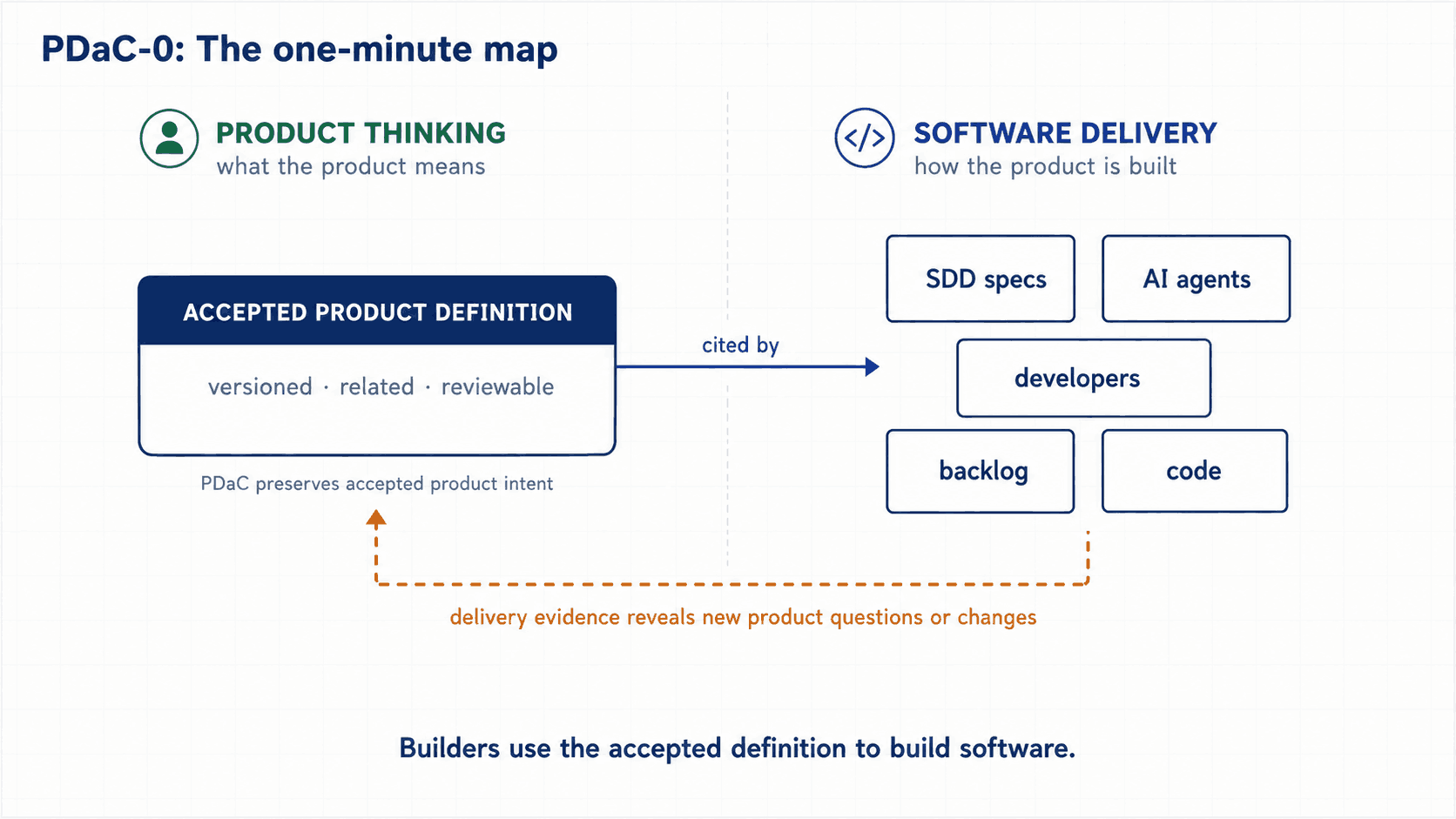
PDaC preserves the accepted definition of the product. Everything that builds software uses it. Note what the picture does not claim: PDaC does not control delivery.
PDaC-1 · Product Definition Context
Section titled “PDaC-1 · Product Definition Context”What is inside PDaC, and what remains outside?
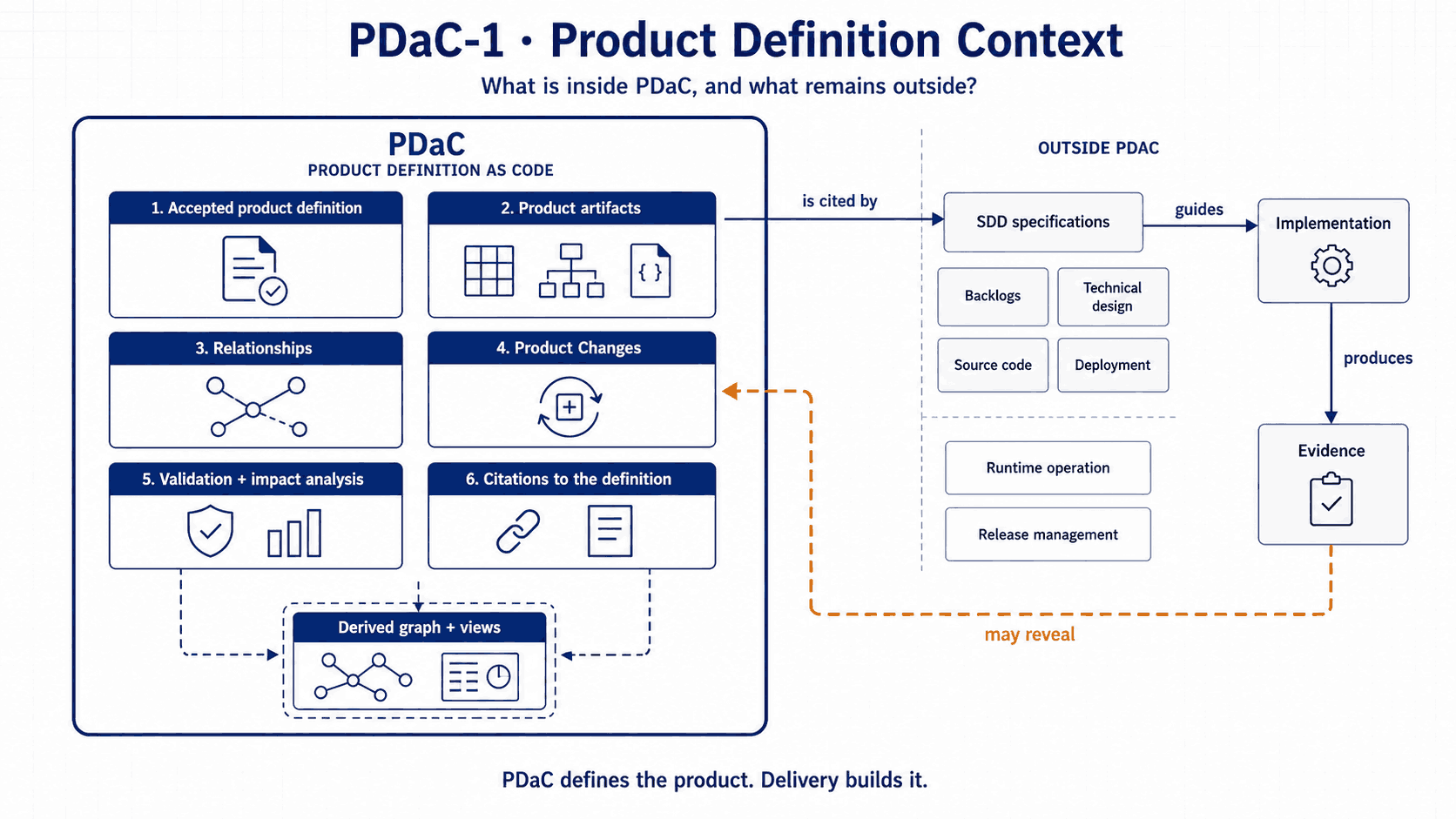
The boundary drawn explicitly. Evidence from delivery may reveal a Product Change. The dashed return path represents learning, not an automatic obligation. Authoritative: the specification.
PDaC-2 · Product Definition Model
Section titled “PDaC-2 · Product Definition Model”What does it mean to define the product?
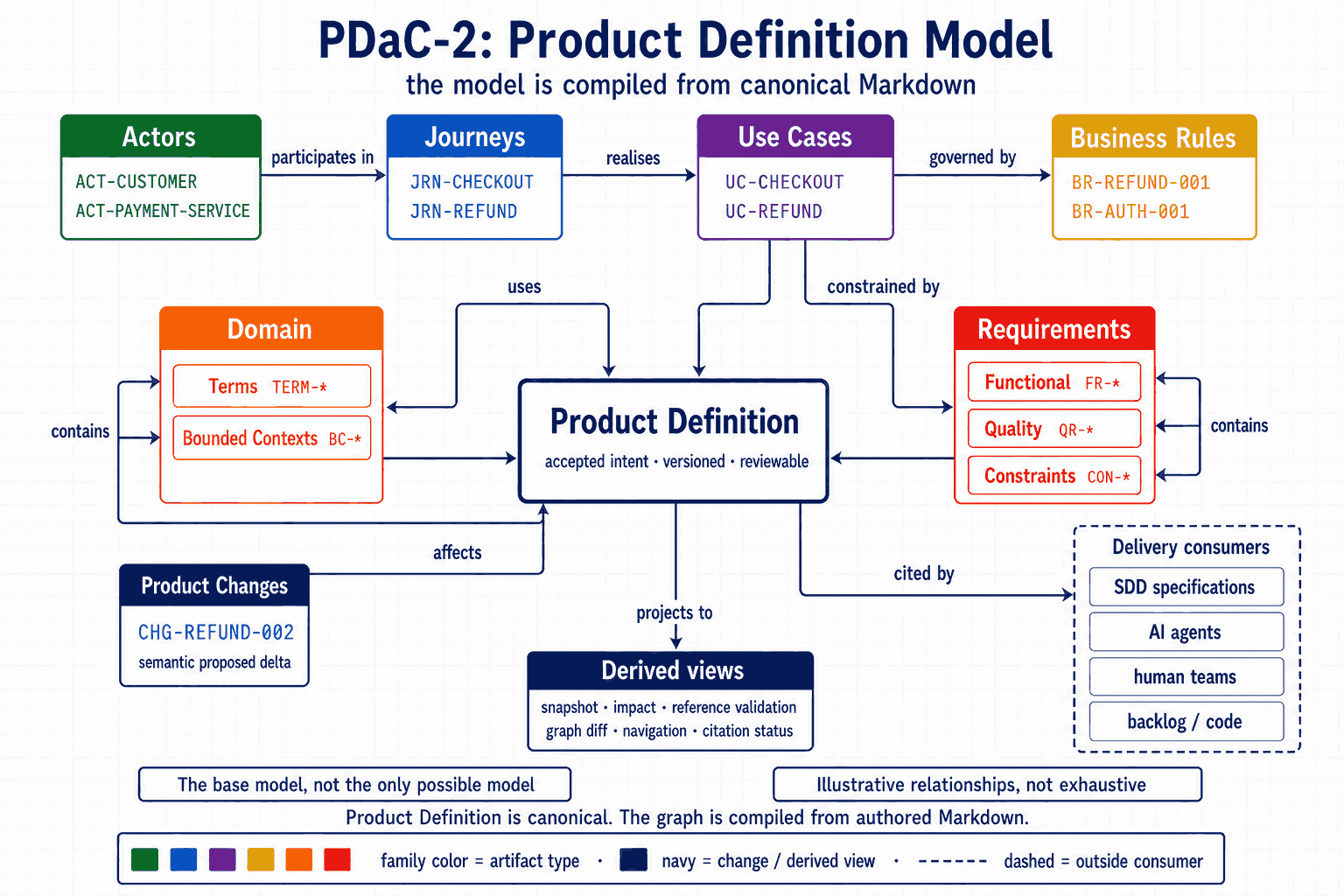
The definition is the boundary around the ten artifact kinds that compose it. They use seven colour families: domain terms share one with bounded contexts, and the three requirement kinds share another. Below the definition are the Product Change that moves it, the views derived from it and the delivery consumers that cite it. Structured Behaviour has its own teal family. This is the base model currently formalised, not the only model possible, and the arrows shown are illustrative rather than exhaustive. Authoritative: Artifacts.
PDaC-3 · Source to Graph
Section titled “PDaC-3 · Source to Graph”How is the graph obtained?
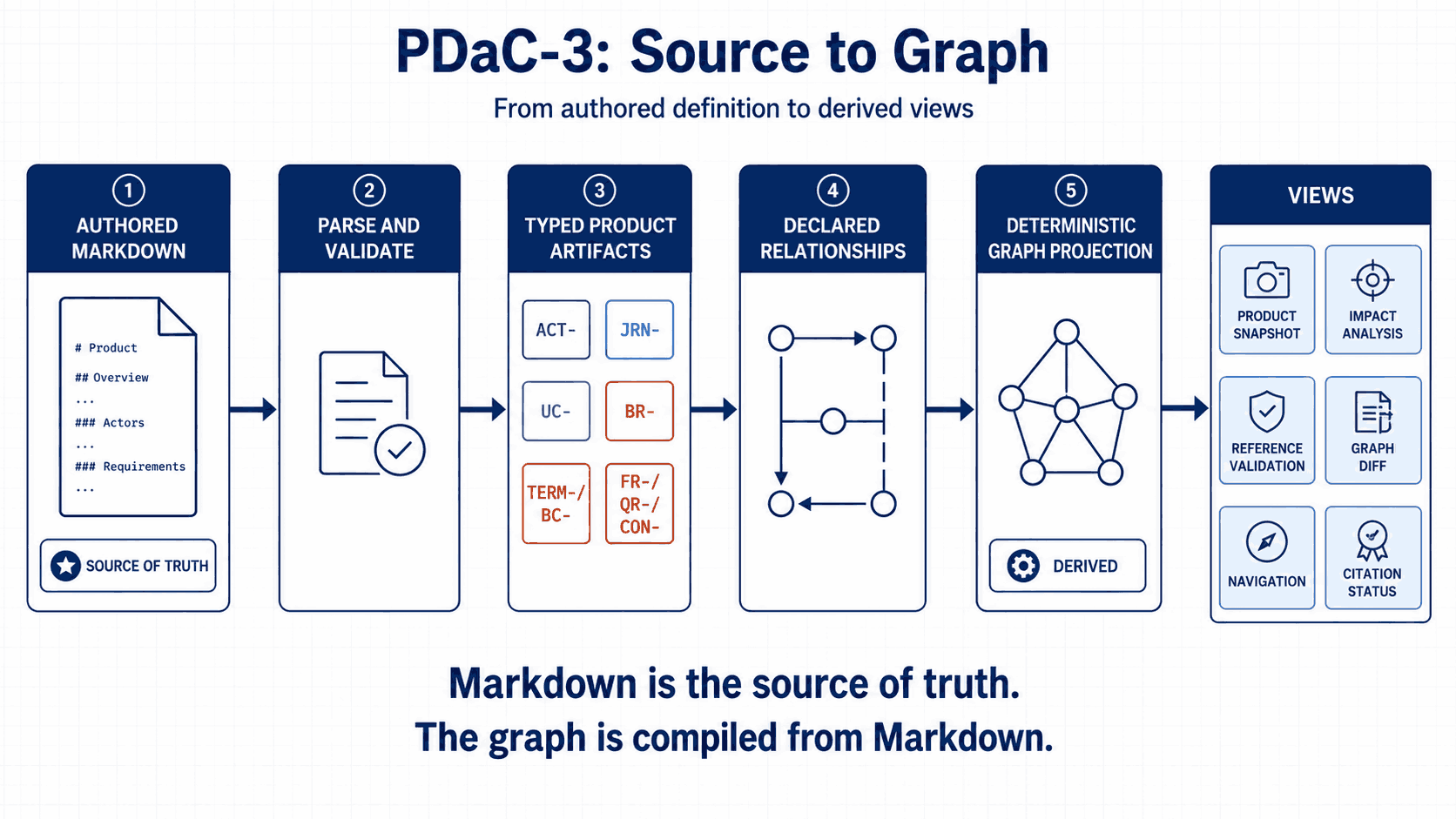
The conceptual architecture of an implementation. It describes a transformation of information, not a deployed application. Authoritative: manifesto principle 2 and Validation.
PDaC-4 · Product Change
Section titled “PDaC-4 · Product Change”How does the accepted definition change?
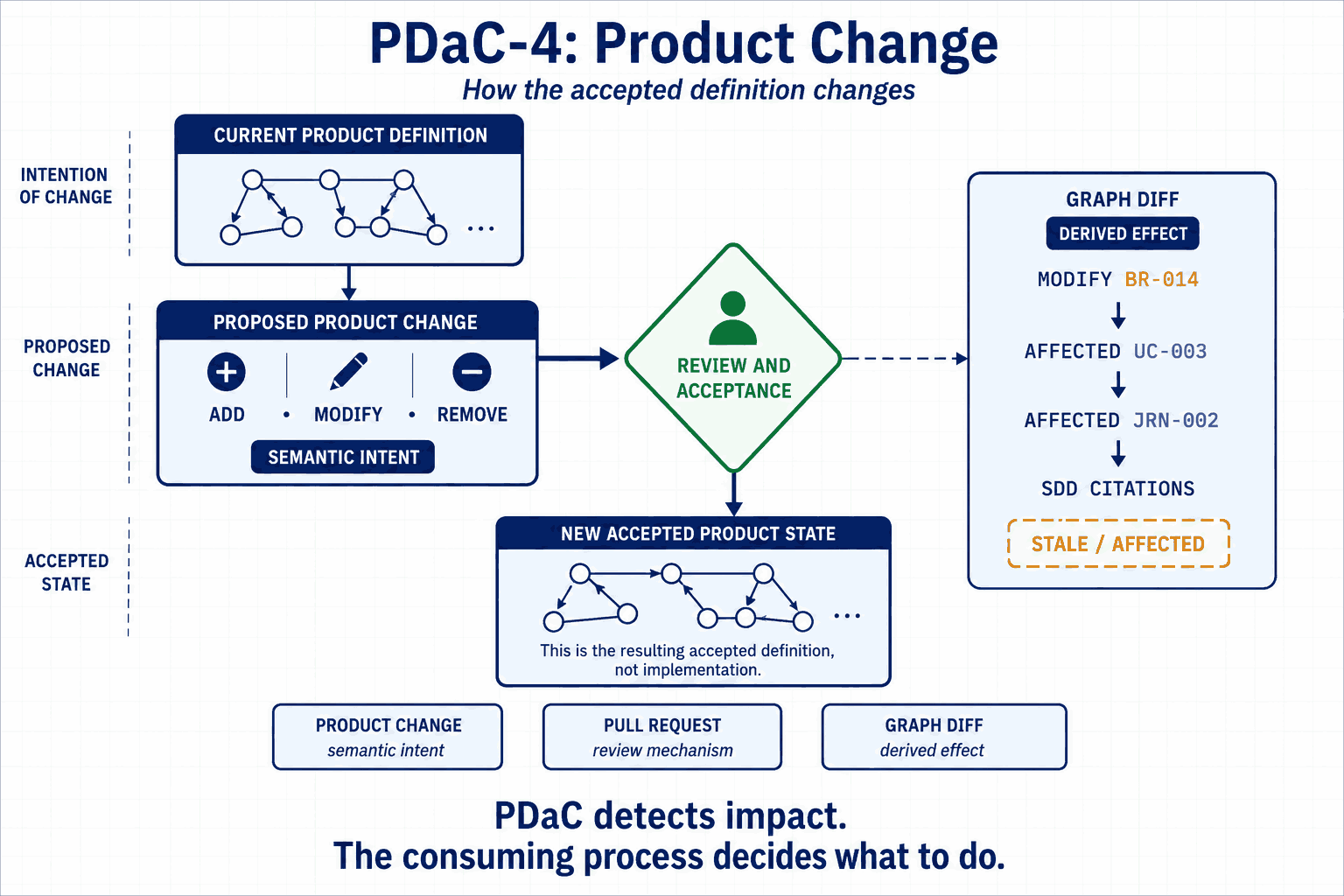
Three things kept apart that are routinely conflated: the Product Change is semantic intent, the pull request is the review mechanism, and the graph diff is a derived effect. In the v0.3.0 candidate, apply forecasts the affected citation set before acceptance. Unresolved model impact can block apply; downstream citations reported as stale are surfaced for review and do not block it by themselves. Citations go stale, never automatically propagated. Authoritative: Product Changes.
PDaC-5 · Citation and Drift
Section titled “PDaC-5 · Citation and Drift”How does PDaC connect to a consumer without replacing it?
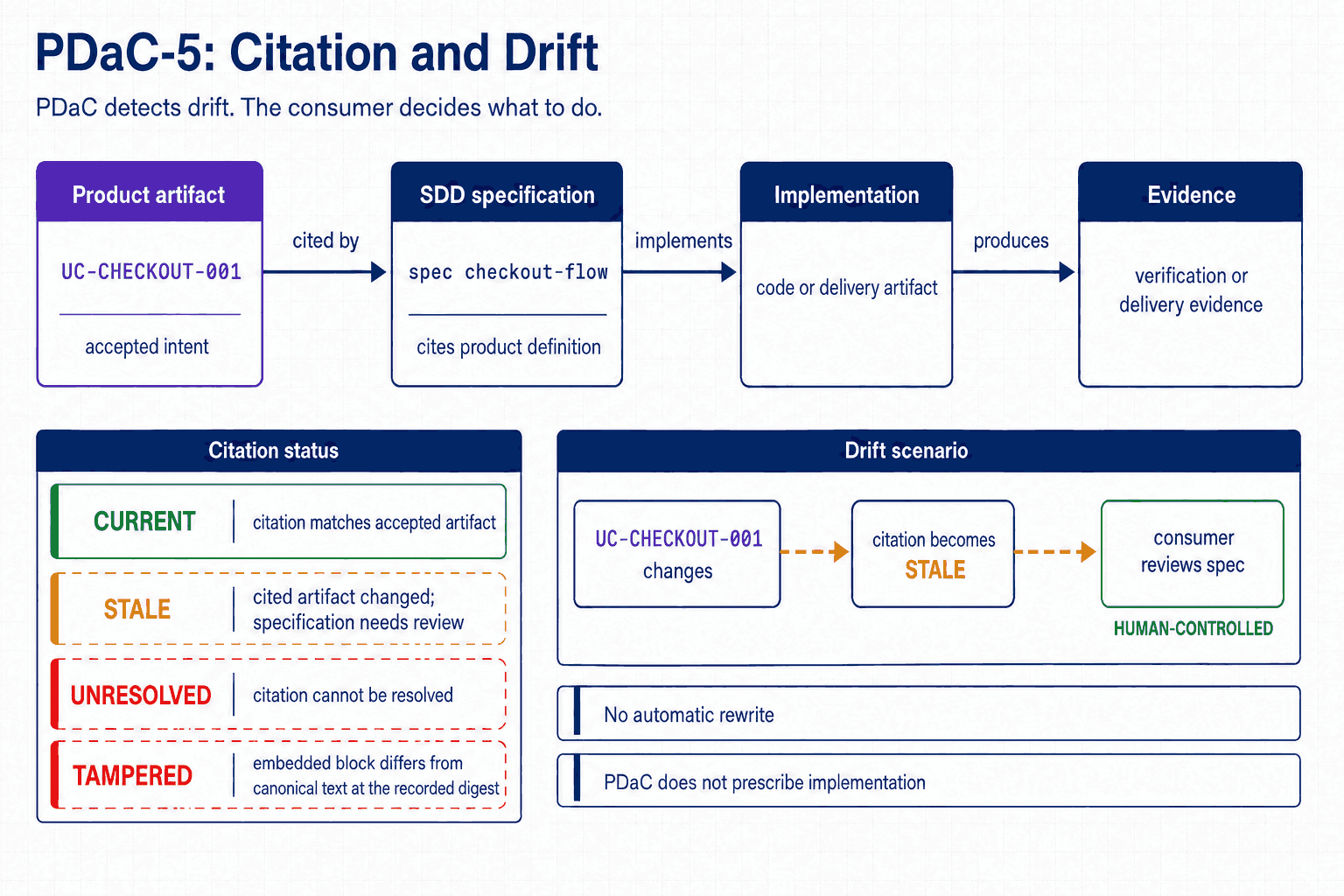
The diagram for anyone asking how this relates to OpenSpec, Spec Kit, Claude Code, Copilot or any other coding agent. The specification is never rewritten for you, and PDaC does not decide how anything is implemented. Authoritative: Citation Contract.
PDaC-6 · Impact Analysis
Section titled “PDaC-6 · Impact Analysis”What happens when one part of the product changes?
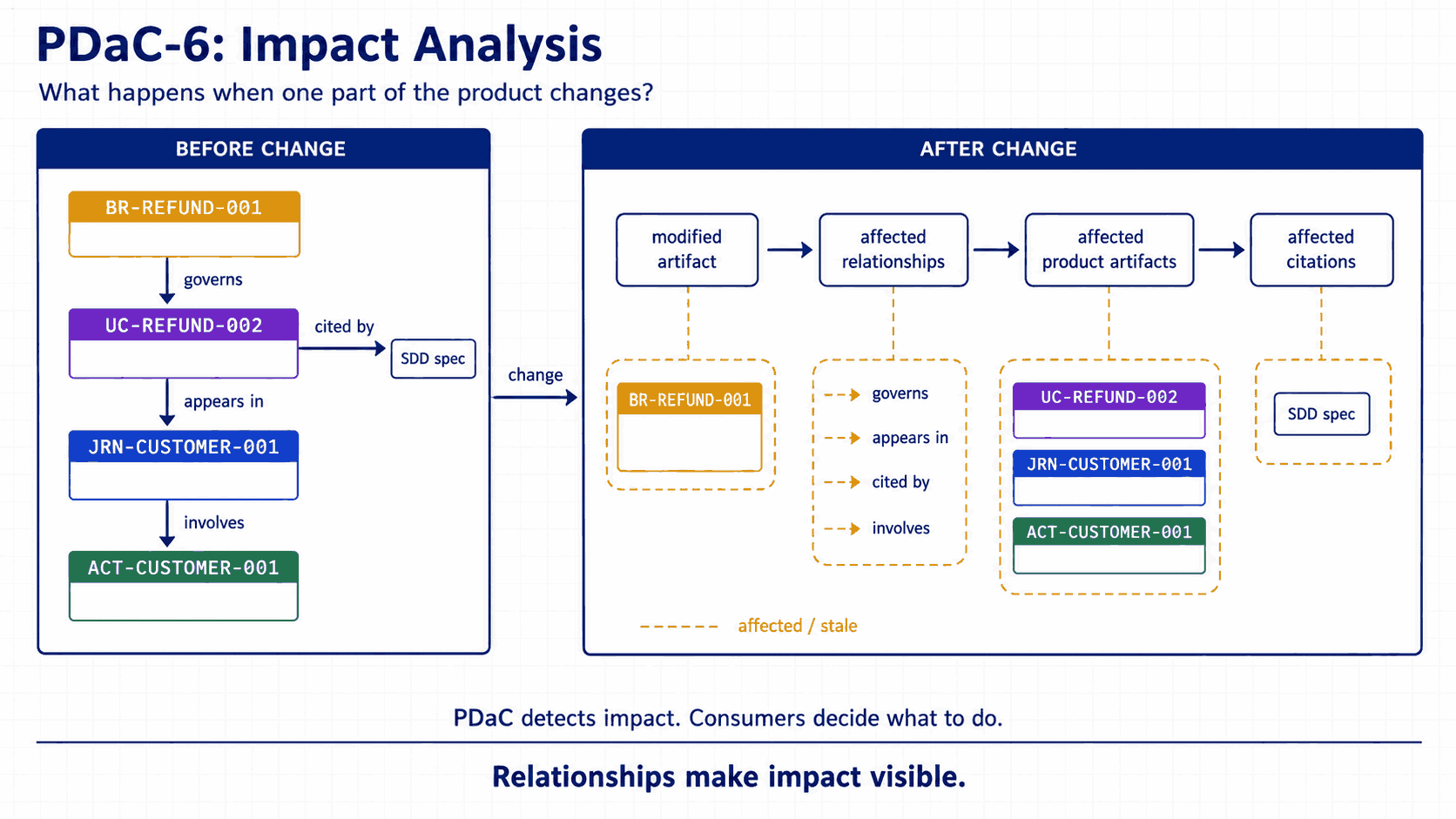
Why the relationships are the methodology, rather than a nicety. Impact follows the declared polarity of each relationship and stays within the one-hop neighbourhood defined by the changed Product Change. It does not blindly walk every incoming and outgoing edge. Separate valid causes remain visible even when they reach the same candidate. Affected artifacts carry a dashed amber border and the word affected or stale; colour never carries meaning alone. Authoritative: Relationships.
PDaC-7 · Definition Ahead of Implementation
Section titled “PDaC-7 · Definition Ahead of Implementation”Why should the product definition not trail the code?
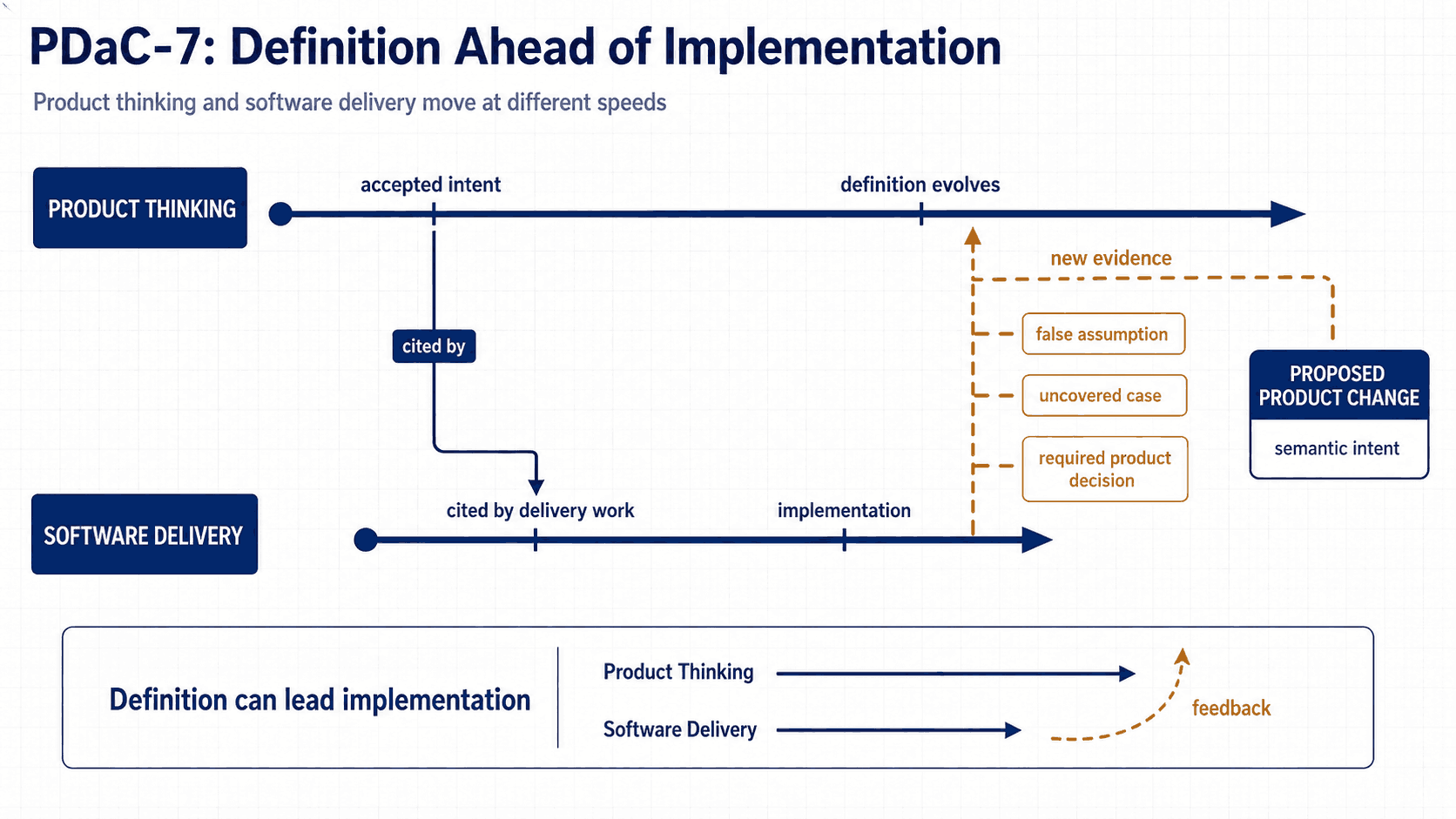
The thesis. Not five mandatory phases: two speeds, and a feedback path between them. One-way authority, two-way learning. Authoritative: the manifesto.
PDaC-8 · Verification Derivation and Continuity
Section titled “PDaC-8 · Verification Derivation and Continuity”How do we know the implementation still satisfies the accepted definition?
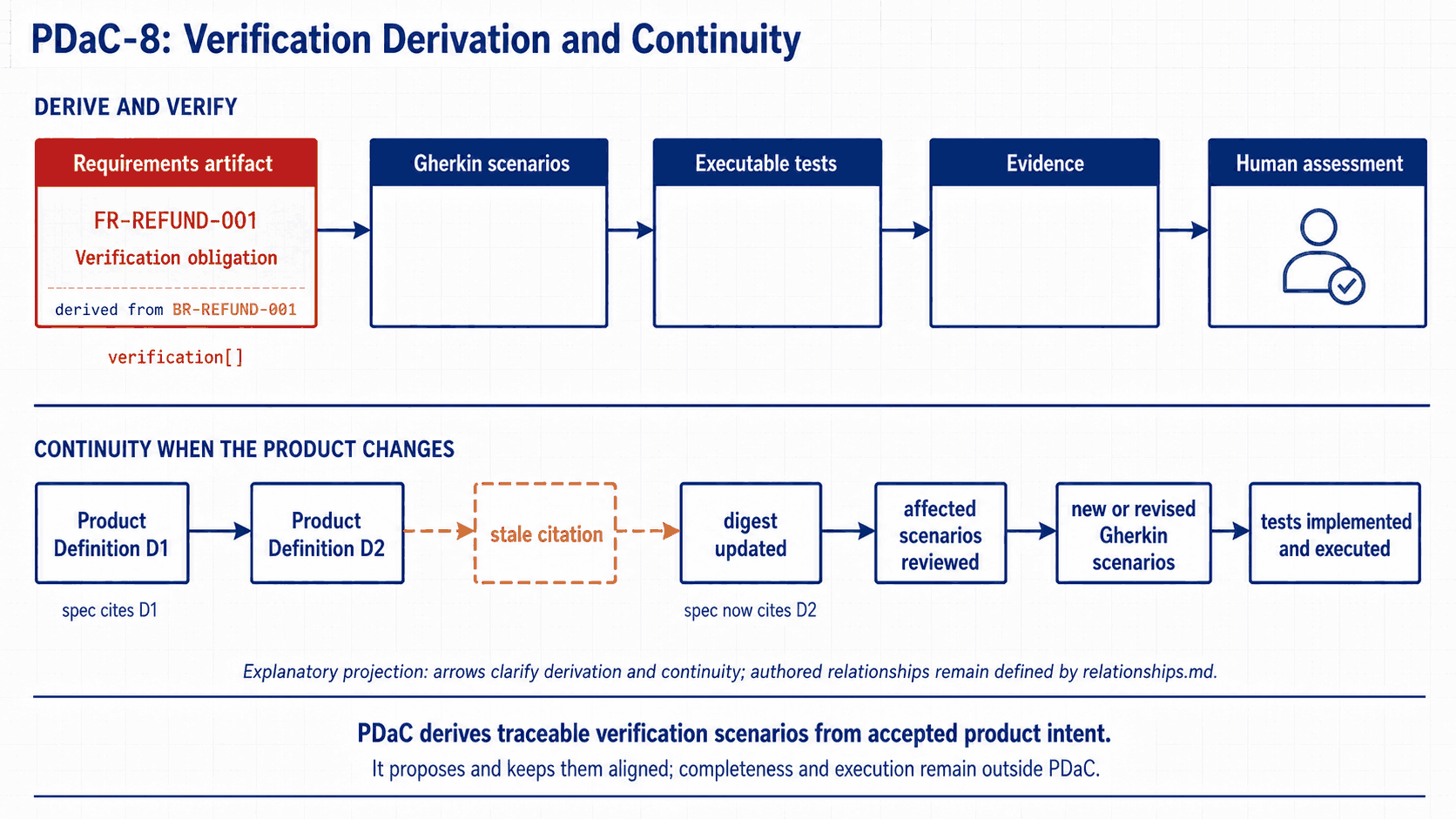
Functional and Quality Requirements can contain an inline verification scenario or refer to an independent Structured Behaviour through scenario-ref. An inline scenario is cited through an anchor on its Requirement. A Structured Behaviour is cited directly by its own ID and the digest of the whole artifact. v0.3.0 also permits a small external Verification Evidence record to cite the product behaviour it verifies. That record is traceable evidence of an external run, not a test-management subsystem: PDaC does not schedule, execute or judge the test. Authoritative: Artifacts, Verification Evidence and the Citation Contract.
Using them
Section titled “Using them”The diagrams are licensed CC BY 4.0, like the rest of the specification text. Their canonical home is assets/diagrams/ in the spec repository, and every copy on this site is generated from it.
To use one in a talk, an article or a README, link to it rather than re-uploading it:
https://pdac.dev/diagrams/pdac-0-one-minute-map.png