
Citation Contract
A citation is a machine-verifiable reference from any consumer document - a Spec-Driven Development (SDD) spec, a task, an agent prompt file, a design doc - to canonical product text. This chapter uses “the consumer” for all of them.
The citation contract is the delivery boundary of Product Definition as Code. Consumers do not re-state product knowledge; they cite it. A citation records what was cited and at what content digest, so that drift between a consumer document and the canonical model is machine-detectable rather than silent.
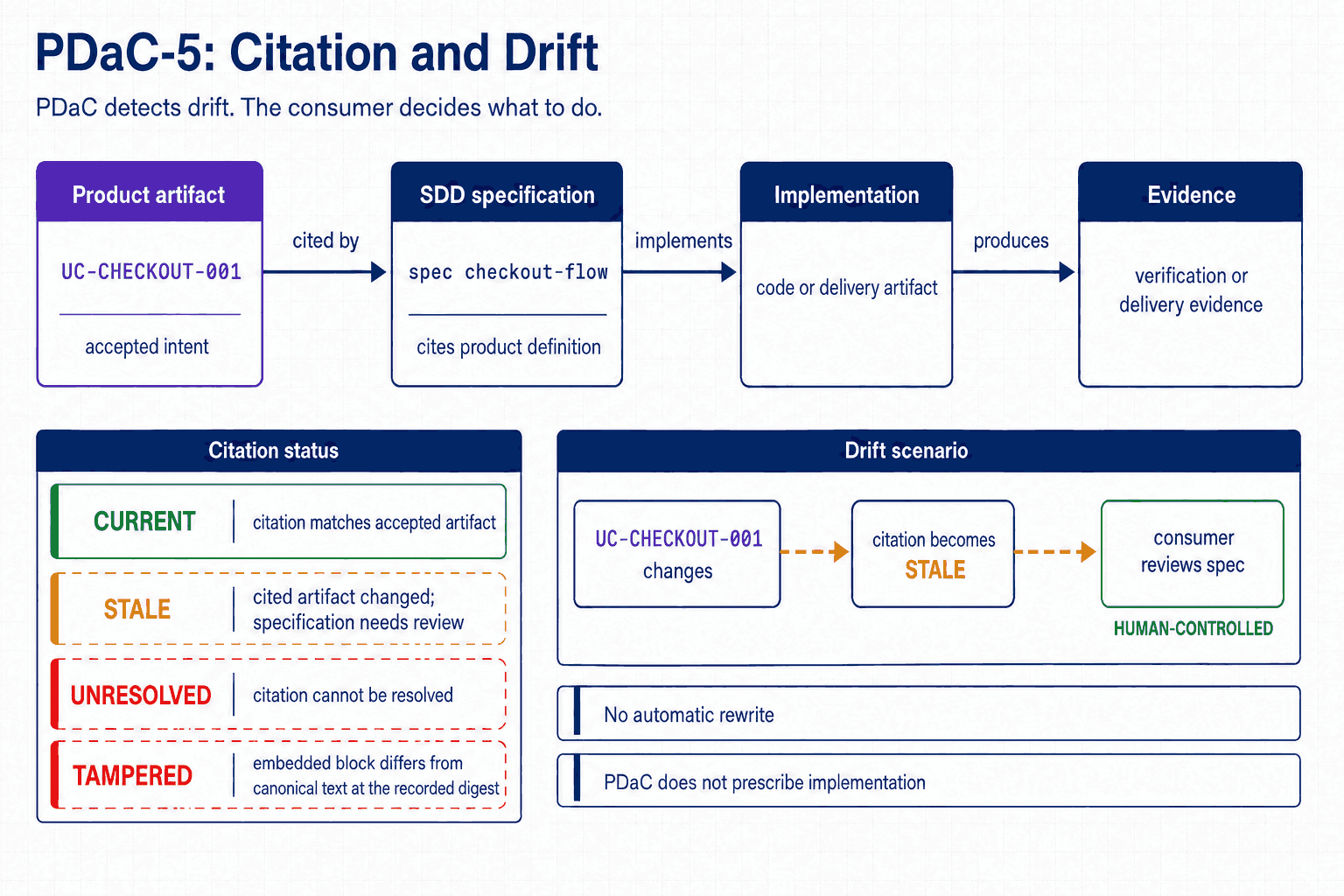
Figure PDaC-5 - how does PDaC connect to a consumer without replacing it? Non-normative; this chapter is authoritative.
Citation record
Section titled “Citation record”A citation is a record, not a block of text. It MUST carry:
| Field | Presence | Meaning |
|---|---|---|
id | required | the target artifact’s stable ID (see Identifiers) |
digest | required | the whole target artifact’s content digest (see Validation → Digests) |
anchor | optional | a stable address within the target artifact (see Anchors below) |
Citation carriers and canonical writing
Section titled “Citation carriers and canonical writing”A consumer document MUST use exactly one carrier: one or more comment payloads in the document, or one adjacent YAML sidecar. It MUST NOT combine them.
A comment payload occupies one physical line and uses this exact attribute order, separated by one or more ASCII spaces or tabs:
pdac:cite id="<artifact-id>" digest="<digest>" [anchor="<anchor>"]Values are double-quoted and have no escape syntax. Unknown, repeated or out-of-order attributes are invalid. Discovery scans text lines for the exact pdac:cite token followed by payload-like id= text; a malformed candidate produces PRODUCT067 rather than disappearing as prose. The payload rides inside the host format’s native comment, whose opener and closer carry no citation semantics.
For a consumer named <stem>.<extension>, the adjacent sidecar is <stem>.citations.yml, replacing only the final extension; a consumer with no extension appends .citations.yml. The sidecar MUST satisfy the normative citation-sidecar schema: one YAML 1.2 document, exactly one top-level citations key, and a non-empty sequence of closed citation records. Duplicate YAML keys, aliases, anchors, tags and merge keys are forbidden. The corresponding consumer file MUST exist. A ledger entry’s location is its one-based sequence position.
citations: - id: FR-CHECKOUT-001 digest: sha256:0123456789abcdef0123456789abcdef0123456789abcdef0123456789abcdef anchor: S1A conforming writer emits only these forms. Payload attributes are written in id, digest, anchor order with one ASCII space between elements. Sidecars are written in mapping form with citations, preserving requested entry order and field order id, digest, anchor. A writer MUST migrate a legacy bare-sequence sidecar when updating it and MUST NOT emit the legacy brace form, a bare-sequence sidecar, mixed carriers or a scenario-only digest. Readers MAY accept legacy forms as explicitly non-conforming extensions.
Payload verification and impact output report the consumer file and one-based line; sidecars report the ledger file and one-based entry.
Anchors
Section titled “Anchors”An anchor addresses a location within the target artifact. In v0.3, an anchor is an inline verification scenario’s stable id (see Frontmatter reference → verification): a citation with anchor: S1 on target FR-X addresses the inline scenario whose id is S1 within FR-X. Scenario anchors make partial dependency scope expressible as a set of cited scenario ids instead of prose.
An anchor does not narrow digest scope. Every citation digest covers the whole target artifact. A verifier resolves the target and anchor, then compares the recorded digest with the whole artifact’s recomputed digest. Any normalized-byte edit to that artifact makes the citation stale, including an edit to another scenario or to artifact prose; an edit to another artifact does not. The anchor tells a reviewer what was relied on, while whole-artifact staleness conservatively requires review of any change to its containing requirement (RFC 0077).
Section-slug anchors (addressing a required body section by its heading slug) are deferred to a follow-up. Restricting v0.3 anchors to inline scenario ids keeps citation resolution deterministic (manifesto principle 10) and avoids non-ASCII heading canonicalization.
A scenario-ref does not create an anchor within its parent Requirement. The referenced Structured Behaviour is a Product Artifact with its own ID and whole-artifact digest, so it is cited directly. An anchor on a Structured Behaviour does not resolve and produces PRODUCT063 unless a later specification version defines anchors within that artifact kind.
Structured Behaviour reliance and projections
Section titled “Structured Behaviour reliance and projections”A consumer that relies on behaviour carried by a scenario-ref MUST cite each referenced Structured Behaviour on which it relies directly. Citing the parent Requirement alone records reliance on the obligation, not on the referenced behaviour. Citation completeness is a semantic review question: implementations MAY suggest a suspected omission for human review, but MUST NOT emit a deterministic conformance diagnostic for it.
A direct Structured Behaviour citation uses its own ID, the existing whole-artifact digest and no anchor:
pdac:cite id="SB-CANCEL-PAID-ORDER" digest="sha256:<64 lowercase hex digits>"An implementation MAY render a consumer-specific projection from an accepted Structured Behaviour. A projection is generated, non-canonical consumer material and MUST carry a citation to the Structured Behaviour from which its product semantics came. Generating a projection MUST NOT create, approve, apply or accept a Product Change and MUST NOT claim that any test was implemented or executed. Provider-specific syntax and validity remain the provider’s responsibility.
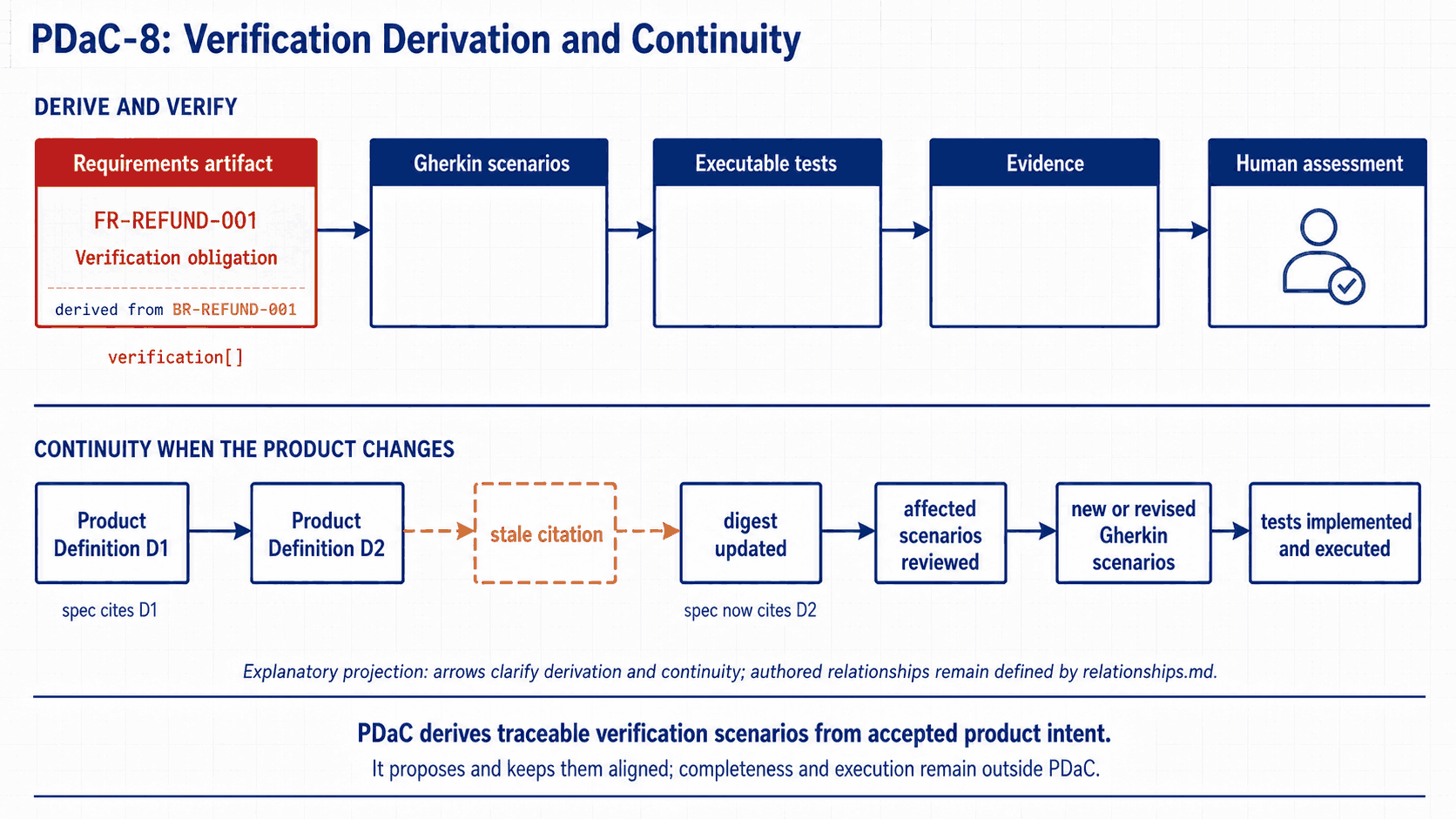
Figure PDaC-8 - how does a scenario-anchored citation stay aligned when the definition changes? Non-normative; Artifacts and the Frontmatter reference are authoritative for verification scenarios.
Embedding
Section titled “Embedding”Embedding is a projection of a citation, not its definition. A consumer MAY additionally embed the cited canonical text in its document; when it does:
- the opening marker MUST carry a valid citation payload and the closing marker MUST carry the exact
/pdac:citetoken in the same host comment style; - the embedded text MUST be byte-identical to the canonical text at the recorded
digest; - the embedded block MUST be treated as read-only and regenerable.
A consumer that embeds canonical text without a citation record, or whose embedded text differs from canonical content at the recorded digest, is non-conforming (see PRODUCT062 below). Because the digest covers the whole artifact, an anchored embedded projection MUST embed the whole artifact. A scenario-only projection cannot be verified by that digest and is PRODUCT062.
A tool decides whether an embedded block is faithful by recomputing the digest of the embedded text and comparing it to the recorded digest, under the same normalization (Validation → Digests). The comparison is against the recorded digest, never against the target’s current content, so a projection that was edited by hand stays detectable after the cited text has moved.
The embedded byte range begins immediately after the line ending that terminates the opening-marker line and ends immediately before the first byte of the closing-marker line. The marker lines and the opening marker’s terminating line ending are not part of the projection. A line ending immediately before the closing marker is part of the projection, so the projection preserves the artifact’s final line ending when the artifact has one.
Statuses
Section titled “Statuses”A conforming tool MUST compute, deterministically, exactly one status per citation:
| Status | Meaning |
|---|---|
current | The target resolves and its recomputed digest matches the recorded digest. |
stale | The target resolves, but canonical content changed since the citation was recorded. |
tampered | Only for embedded projections: the block differs from canonical content at the recorded digest. |
unresolved | The target id does not resolve, or the anchor does not resolve within the target. |
Digest recomputation uses the normalization defined in Validation → Digests. Staleness is judged exclusively by the whole-artifact digest of the cited target: unrelated commits, edits to other artifacts and generated-file churn MUST NOT make a citation stale. Any normalized-byte edit to the target artifact does.
Applying a Product Change computes the product diff between the baseline and the applied result (Product Changes → Apply). The affected citation set is derived from that diff and the citation index, not from the change’s declared operations: a citation goes stale because the text it cited effectively changed, never because a change said it would.
Precedence
Section titled “Precedence”More than one condition can hold for the same citation: an embedded block edited by hand whose cited text has since moved satisfies the tampered and the stale condition at once. Because exactly one status is computed, the conditions are evaluated in this order and the first that holds decides:
| Order | Condition | Status | Diagnostic |
|---|---|---|---|
| 1 | The recorded digest is not a well-formed digest. | unresolved | PRODUCT042 |
| 2 | The target id does not resolve. | unresolved | PRODUCT060 |
| 3 | The anchor does not resolve within the target. | unresolved | PRODUCT063 |
| 4 | An embedded projection is not byte-identical to the canonical text at the recorded digest. | tampered | PRODUCT062 |
| 5 | The target’s recomputed digest differs from the recorded digest. | stale | PRODUCT061 |
| 6 | None of the above. | current | none |
A citation reports the diagnostic of its status and no other: a tampered projection whose target has also moved is PRODUCT062, and PRODUCT061 MUST NOT be emitted alongside it.
Tampering outranks staleness because it is a property of the consumer document that no edit to the canonical text can resolve, while staleness is resolved by the same act that repairs the projection: re-embedding the canonical text and recording its digest. The order also stops an unrelated canonical edit from turning an error into a warning, which would let a consumer document lower the severity of its own defect. Resolution failures are evaluated first because a statement about content presupposes the content: with no well-formed digest, no target, or no anchor within the target, there is nothing to compare.
Diagnostics
Section titled “Diagnostics”| Code | Severity | Condition |
|---|---|---|
PRODUCT042 | error | Invalid or unverifiable citation digest. |
PRODUCT060 | error | Unresolved citation: target id does not resolve. |
PRODUCT061 | warning | Stale citation: target resolves but canonical content changed since the citation was recorded. |
PRODUCT062 | error | Tampered embedded projection: the embedded block differs from canonical content at the recorded digest. |
PRODUCT063 | error | Anchor not found: the target resolves but the named anchor does not exist within it. |
PRODUCT064 | error | Current consumer document has no scope declaration during population-aware verification. |
PRODUCT065 | error | Consumer document declares bound but contains no citations. |
PRODUCT066 | error | Invalid exemption: empty reason or an exempt document containing a citation. |
PRODUCT067 | error | Malformed citation carrier, missing sidecar consumer, or payload/sidecar conflict. |
PRODUCT061 is a warning; a repository MAY make warnings fail the command through validation.warnings-as-errors. Tools MUST NOT apply per-artifact-type severity defaults: risk policy belongs to the repository, not the kernel.
Population-aware consumer verification
Section titled “Population-aware consumer verification”A conforming implementation MAY provide no consumer-framework integration. When it claims population-aware PDaC verification for an integration, the integration MUST satisfy this section (RFC 0042).
A consumer integration is an adapter that deterministically enumerates an external framework’s current native consumer documents without taking ownership of them. It MUST document its enumeration rule, return the same population for identical repository content and integration configuration, exclude archived or historical documents by default, and report provider identity and integration version. Framework paths and lifecycle concepts remain adapter concerns and MUST NOT enter the Product Definition.
Every current document in the enumerated population has exactly one explicit scope declaration:
| Value | Contract |
|---|---|
bound | The document contains product-semantic dependencies and carries at least one citation. |
exempt | The document has no dependency requiring binding and carries a non-empty human-authored reason and no citations. |
The serialization and location of that declaration are adapter-defined but MUST be inspectable as repository data without executing code. Absence is unclassified and produces PRODUCT064; a tool MUST NOT infer exemption from no citations, file name, generated content or AI assessment. A bound document with no citations produces PRODUCT065. An empty exemption reason or an exempt document containing a citation produces PRODUCT066. A tool MUST NOT create or renew an exemption without an explicit human request.
Population-aware verification accounts for every enumerated current document before success. It reports provider and integration version; totals for current, bound, exempt and unclassified documents; citation totals by status; and the source location and diagnostic for every non-passing document. A valid exempt document remains visible. Zero discovered citations cannot succeed when any current document is bound or unclassified. Citation statuses and precedence remain exactly those above.
Success establishes only that the declared population was accounted for, every document was classified, every bound document carried at least one citation and every recorded citation was verified. It does not establish citation completeness, semantic agreement, implementation correctness or delivery status. Tools may suggest omissions for human review but MUST NOT report such suggestions as deterministic conformance results.
A stale citation requires review. A tool MUST NOT renew its digest, rewrite consumer text or change the canonical Product Definition automatically. The consumer owner either revises and deliberately re-cites accepted intent or proposes a Product Change; acceptance remains human-controlled.
Semantic contradiction
Section titled “Semantic contradiction”Semantic contradiction between a citation and its surrounding consumer text is explicitly non-normative. Tools MAY flag suspected contradictions for human review; such findings are never a conformance criterion. Deterministic tools enforce structure, AI does semantic work, humans decide (manifesto principle 7).
Delivery boundary
Section titled “Delivery boundary”Consumers of the model (SDD frameworks, AI agents, human teams) retain native ownership of their own artifacts and workflow. A consumer MUST NOT write to the canonical product model. A consumer MAY propose a Product Change when implementation reveals a contradiction; a human decides whether to approve and accept it (manifesto principle 9). Acceptance is a human decision: tools MUST NOT merge, auto-approve or self-merge model changes.
A cited model may live in a repository of its own: Conformance → Topologies defines the co-located and dedicated topologies and the pointer a consuming repository carries to a dedicated model repository. Cross-repository citation resolution is a different question and remains out of scope for v0.3: how a tool verifies a citation digest against a model repository the consumer does not contain, and what that tool reports when the repository is unreachable, are deferred (RFC 0021). Citations resolve within one repository in v0.3.
Generated context documents
Section titled “Generated context documents”A repository MAY generate a readable document composed entirely of citations, for the convenience of a consumer that prefers a single bundle over resolving citations individually. Such a generated document is non-canonical, reproducible from the citations it contains, and carries an explicit size budget it never silently exceeds. It is not a PDaC artifact and is not required for conformance; the citation contract is the normative surface, not any generated bundle.
Lifecycle and evidence integration
Section titled “Lifecycle and evidence integration”A Domain Lifecycle is citable as a whole artifact. State and transition IDs are local selectors, not citation anchors; an anchor on a lifecycle produces PRODUCT063. Optional Verification Evidence adapters reuse citation records, hashing and precedence under their narrower target-kind contract. They do not add graph edges or a general-purpose third citation carrier.
Apply and dry run MUST report the affected live citation set after model-impact gates and before writes. That forecast reuses verification’s population and statuses, but its statuses are report data, not emitted consumer diagnostics or apply vetoes.