
Product Definition as Code: Specification
Status: v0.2.0 (request for comments), released 2026-08-28. Extracted from the reference implementation; the public comment period is open, see the repository README for milestones. All chapters are currently at stability level
draftas defined in GOVERNANCE.md.
This is the normative specification for Product Definition as Code; the chapters below define its terms, contracts and conformance criteria.
The key words MUST, MUST NOT, SHOULD, SHOULD NOT and MAY in these documents are to be interpreted as described in RFC 2119.
Human-facing explanations live in the manifesto, in particular the position in full. Where any explanatory text and this specification appear to disagree, this specification wins.
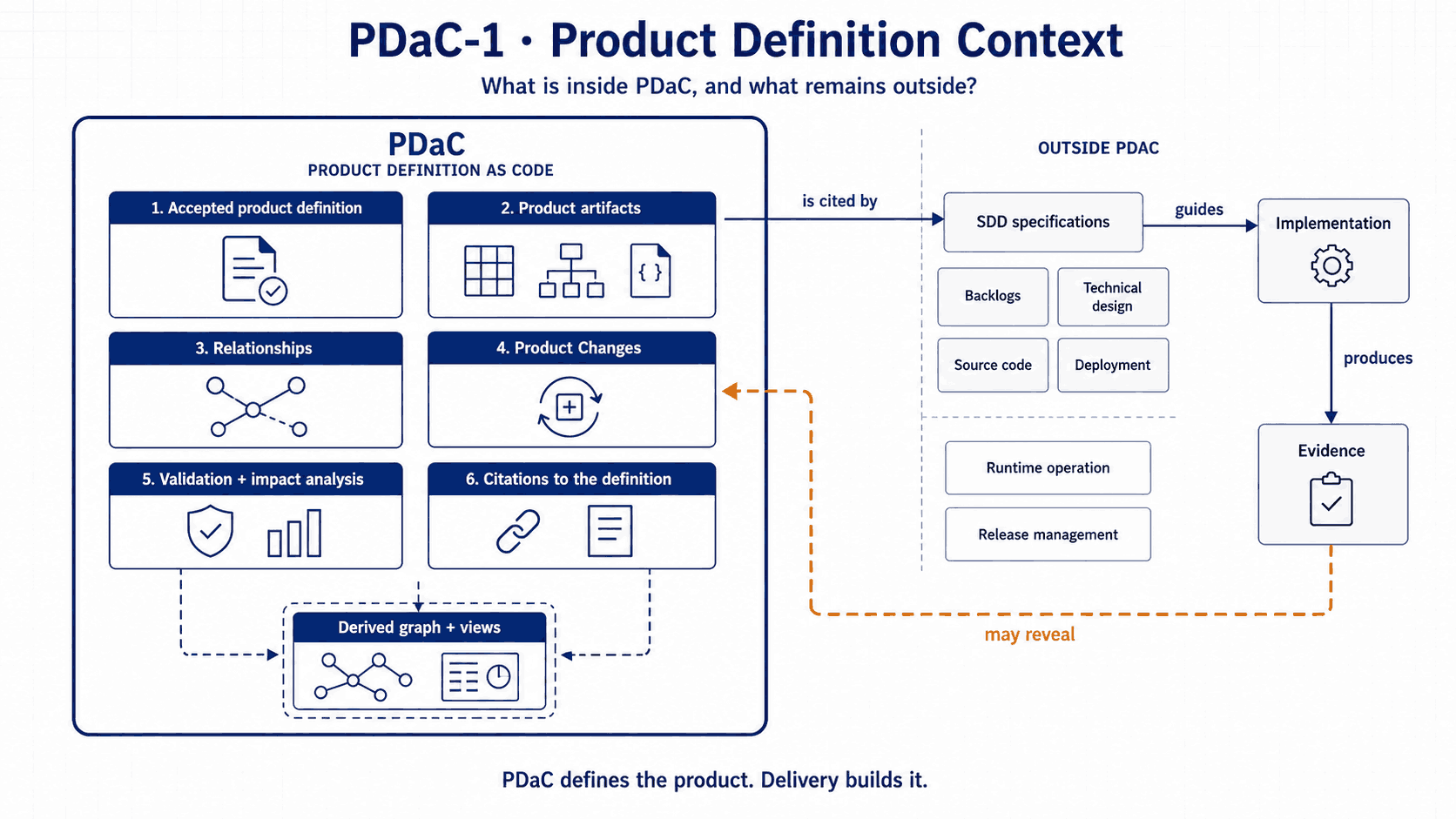
Figure PDaC-1 - what is inside Product Definition as Code and what is outside? Non-normative; the chapters below are authoritative.
Contents
Section titled “Contents”The grouping below mirrors the manifesto’s “a kernel, a profile, a workflow” distinction, as a reading aid. It defines no conformance subset: what conformance means is defined solely by Conformance, which today covers all three groups.
- Terminology - definitions of the terms used normatively.
The kernel - stable identity, typed relationships, verifiable citations, deterministic validation.
- Identifiers - stable immutable IDs, prefixes, grammar, file naming.
- Relationships - canonical relationship vocabulary and derivation rules.
- Citation Contract - machine-verifiable references from consumer documents to canonical product text, citation statuses, the delivery boundary.
- Validation - deterministic diagnostics, stable codes, exit codes.
- Configuration - versioned repository discovery, product root and warning policy.
The reference profile - the artifact vocabulary: opinionated, a good default, distinguished from the kernel on purpose.
- Artifacts - the ten artifact types, frontmatter contracts, required body sections, lifecycle states.
- Frontmatter reference - the exhaustive per-kind field tables: required and optional fields, allowed values, provenance.
The reference workflow - how the accepted definition evolves.
-
Product Changes - change structure, operations, overlay validation, lifecycle, apply, initialisation through
CHG-INITIAL, change history. -
Conformance - what it means for a repository and an implementation to conform, the co-located and dedicated topologies a model repository may take, and the pointer to a dedicated one.
Canonical authority
Section titled “Canonical authority”Within a repository that adopts Product Definition as Code:
| Path | Authority |
|---|---|
docs/product/model/**/*.md | Canonical current product semantics (the accepted Product Definition) |
docs/product/changes/active/**/change.md | Canonical definition of a live Product Change |
docs/product/changes/active/**/proposed/**/*.md | Canonical proposed future-state product semantics for that change |
docs/product/changes/completed/**, docs/product/changes/rejected/**, docs/product/changes/superseded/** | Change history; inert, never compiled into the graph |
Consumer documents outside docs/product/model (SDD specs, tasks, agent prompts, design docs) | Non-canonical; carry citations to canonical product text |
| Graph files, generated indexes, Mermaid diagrams, traceability reports | Generated and non-canonical |
The model/ root is normative; its subdirectory names and nesting are not. An implementation MUST inspect Markdown files recursively below model/, determine each product artifact’s kind from its parsed frontmatter type, and MUST NOT infer or restrict an artifact kind from its path. Repositories MAY group artifacts by kind, domain or another local convention. The lifecycle directories directly below changes/ remain normative because they determine whether a Product Change is live or inert history.
docs/product/model/index.md is a human navigation and orientation document only. It MUST NOT duplicate relationships and MUST NOT act as a generated product index.
Generated files MUST be reproducible from canonical sources at any time. Tools MUST NOT require a generated file to exist in order to rebuild it.