
Artifacts
This chapter defines the artifact types of the current product model, their frontmatter contracts, required body sections and lifecycle states. Product Changes are specified in their own chapter.
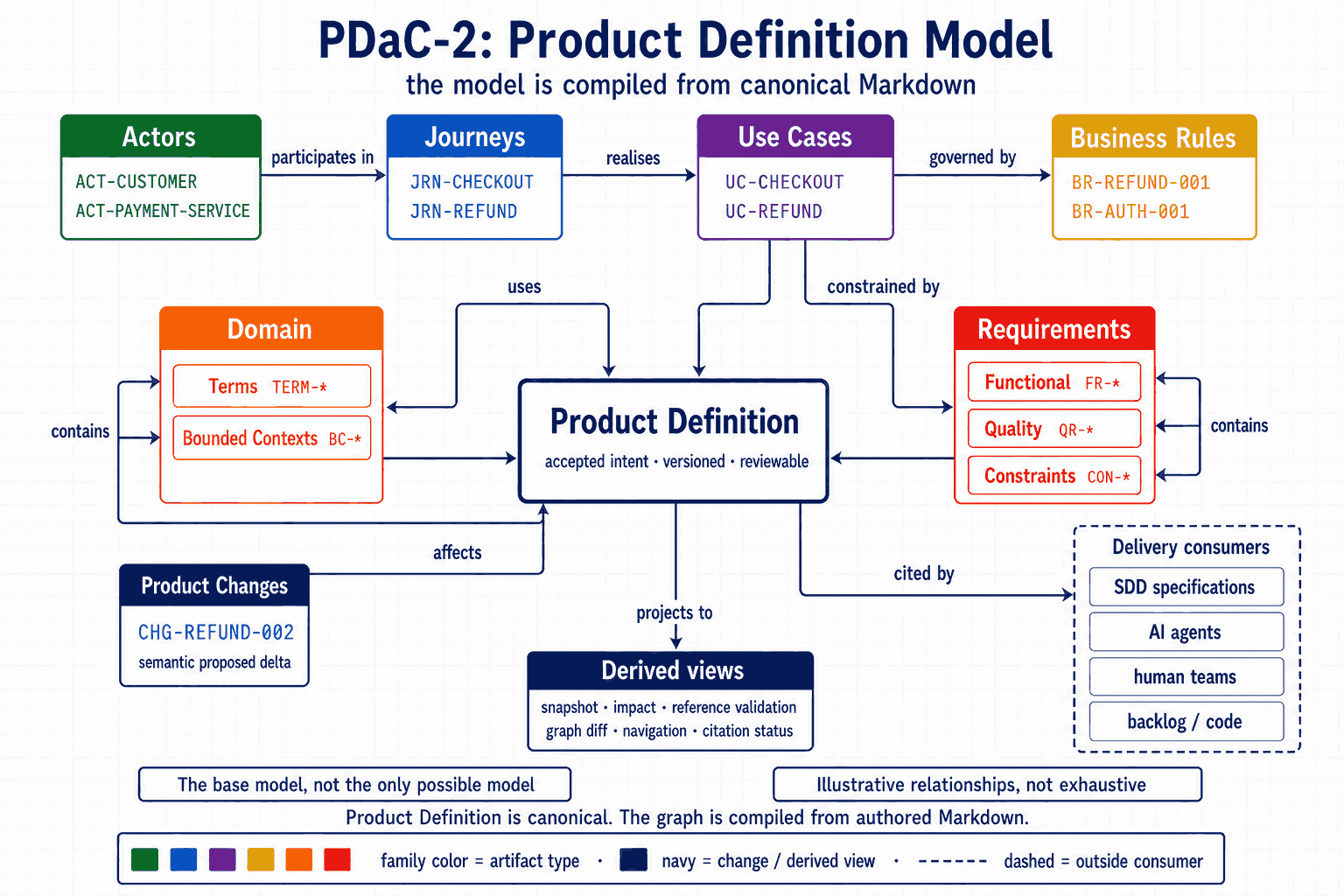
Figure PDaC-2 - what does it mean to define the product? Non-normative; this chapter is authoritative for the types, Relationships for the arrows, Product Changes for the change and the Citation Contract for the consumers.
Common contract
Section titled “Common contract”Every product artifact is a Markdown file whose YAML frontmatter MUST include:
---id: FR-VALIDATE-001 # stable immutable ID, see identifiers.mdtype: functional-requirement # one of the types belowtitle: Detect unresolved artifact referencesstatus: active # artifact lifecycle state---typeMUST be one of:actor,journey,use-case,business-rule,domain-term,bounded-context,functional-requirement,quality-requirement,constraint,structured-behaviour.- Frontmatter MUST validate against the JSON Schema for its
type(schemas/<type>.schema.json). Unknown frontmatter properties are invalid. The exhaustive per-kind field tables (required and optional properties, allowed values, ID patterns) are in the Frontmatter reference, maintained by hand against those authoritative schemas. - The Markdown body MUST contain the required sections for its type as
##headings, in the order listed. Additional sections MAY follow the required ones. - Every artifact type additionally accepts the optional
provenanceobject (Frontmatter reference → Provenance). - Artifacts MUST NOT carry author, owner, date, version or review metadata; Git history is the record of who changed what and when.
provenanceis not an exception to this rule but a different concern: it records the evidence behind recovered knowledge (its source, the confidence that evidence supports, and how it was recovered), and it SHOULD be set only on artifacts recovered from an existing system. - Artifact bodies describe product behaviour and obligations. They MUST NOT contain implementation design (class names, package names, algorithms, framework or storage choices) unless naming an externally imposed, externally visible constraint is unavoidable.
Artifact lifecycle
Section titled “Artifact lifecycle”The artifact lifecycle (artifactStatus) is:
| Status | Meaning |
|---|---|
draft | Incomplete or not yet approved. Not part of the accepted product definition. |
active | Part of the current product definition. |
deprecated | Still present but scheduled for replacement or removal. |
retired | No longer active; retained only for historical traceability. |
Rules:
- An
activeartifact MUST NOT reference aretiredartifact. - A reference from an
activeartifact to adeprecatedartifact SHOULD produce a warning. draftartifacts MAY reference otherdraftartifacts.- This lifecycle applies to product artifacts only. The artifact lifecycle and the Product Change lifecycle are separate state machines and MUST NOT be mixed.
Actor (actor, ACT-)
Section titled “Actor (actor, ACT-)”An Actor identifies who or what interacts with the product to achieve a meaningful outcome.
Additional frontmatter: actor-kind (required), one of human, external-system, scheduled-process, product.
Required body sections: ## Purpose, ## Goals, ## Responsibilities, ## Boundaries.
Actors are not personas. Actor artifacts MUST NOT model demographics or fictional persona details.
Journey (journey, JRN-)
Section titled “Journey (journey, JRN-)”A Journey describes an end-to-end outcome pursued by an actor. It may cross use cases, channels, bounded contexts, external systems, manual activities, waiting periods, branches and failure paths.
Additional frontmatter: primary-actor (required, Actor ID); steps (required, ordered list of - use-case: <UC id> entries defining the main journey).
Required body sections: ## Intended Outcome, ## Entry Conditions, ## Journey Narrative, ## Variants and Branches, ## Completion Conditions.
Branches and exceptional paths belong in the body. There is no workflow DSL: steps defines the main ordered path only. Journeys MUST NOT describe screen-by-screen UI behaviour unless the UI sequence is materially part of the product behaviour.
A Journey MAY reference a Use Case in steps when that Use Case occurs on the Journey’s main ordered path. A Use Case MAY be referenced by zero, one or multiple Journeys. Absence of an incoming steps[].use-case relationship does not make a Use Case invalid.
Use Case (use-case, UC-)
Section titled “Use Case (use-case, UC-)”A Use Case describes a concrete interaction through which an actor obtains a product outcome.
Additional frontmatter: primary-actor (required, Actor ID); supporting-actors (optional, list of Actor IDs); bounded-context (optional, Bounded Context ID); governed-by (optional, list of Business Rule IDs); uses-terms (optional, list of Domain Term IDs).
Required body sections: ## Goal, ## Trigger, ## Preconditions, ## Main Flow, ## Alternative Flows, ## Failure Conditions, ## Postconditions.
The body describes observable behaviour, not implementation design.
Journey context is optional. A Use Case MAY be referenced by zero, one or multiple Journeys (see Journey). An implementation MUST NOT emit a conformance diagnostic solely because an active Use Case is not referenced by a Journey. It MAY surface the absence as non-conformance advice for human review, for example to ask whether the Use Case contributes to a wider actor outcome, occurs only on a branch, or is intentionally standalone.
Business Rule (business-rule, BR-)
Section titled “Business Rule (business-rule, BR-)”A Business Rule expresses durable product knowledge that governs behaviour. A rule that applies to multiple use cases or requirements MUST be independently identifiable and reusable rather than hidden inside stories, acceptance criteria, UI validation, code, database constraints, tests or SDD tasks.
Additional frontmatter: applies-to (optional, list of Journey, Use Case or Bounded Context IDs); uses-terms (optional, list of Domain Term IDs).
Required body sections: ## Rule, ## Rationale, ## Examples, ## Exceptions.
The ## Rule section MUST contain one clear normative statement.
The ## Examples section MAY contain local illustrations that do not require independent identity, reuse, lifecycle or citation. When a concrete, testable example is authored as a Structured Behaviour, that artifact is the canonical carrier of its clauses and illustrates is the canonical association to the Business Rule. The Business Rule body MUST NOT present an authored restatement as a second canonical carrier. It MAY mention the Structured Behaviour ID or contain non-canonical explanatory prose. It MAY carry a restatement only as a non-canonical projection that cites the Structured Behaviour and follows the embedding rules. Whether differently worded prose restates the same behaviour is a review question, not a deterministic validation rule.
Domain Term (domain-term, TERM-)
Section titled “Domain Term (domain-term, TERM-)”A Domain Term establishes shared meaning.
Additional frontmatter: defined-in (required, Bounded Context ID); synonyms (optional, list of strings); uses-terms (optional, list of Domain Term IDs).
Required body sections: ## Definition, ## Distinguish From, ## Usage.
A term’s definition MUST NOT merely repeat its title.
Bounded Context (bounded-context, BC-)
Section titled “Bounded Context (bounded-context, BC-)”A Bounded Context is a product-language boundary: it delimits where a set of domain terms carries a specific meaning. Bounded contexts in v0.2 do not imply aggregates, implementation modules or source-code structure.
Additional frontmatter: none beyond the common contract. In particular, owns-terms MUST NOT be authored: term ownership is derived from Domain Term.defined-in (see Relationships).
Required body sections: ## Responsibility, ## Language, ## Boundaries, ## External Relationships.
Functional Requirement (functional-requirement, FR-)
Section titled “Functional Requirement (functional-requirement, FR-)”A Functional Requirement is a derived product obligation stating what the product must do.
Additional frontmatter: derived-from (required, non-empty list of Use Case, Business Rule or Constraint IDs); verification (required, non-empty list whose entries are either an inline scenario with an optional stable id for citation anchoring, or exactly one scenario-ref naming a Structured Behaviour; see Frontmatter reference); uses-terms (optional, list of Domain Term IDs).
Required body sections: ## Requirement, ## Rationale.
The ## Requirement section MUST use explicit normative language. A requirement MUST NOT be a disguised implementation task and MUST retain traceability to the product knowledge it derives from.
An inline verification[].scenario is the canonical carrier of that acceptance criterion. A verification[].scenario-ref is the canonical authored relationship to a Structured Behaviour. An item MUST use exactly one form and MUST NOT carry unknown properties. Inline and reference entries MAY be mixed in one Requirement, and inline verification remains conforming. The same Structured Behaviour MAY verify more than one Requirement. The same expected behaviour MUST NOT appear as both forms in the same Requirement. Whether differently worded entries express the same behaviour is a review question, not a deterministic validation rule.
The body SHOULD NOT restate verification criteria. A body section that reproduces them is a projection, not a second source. An artifact MAY carry such a projection; when it does, the projection MUST follow the embedding rules, so that a copy edited by hand is detectable rather than silently divergent.
Quality Requirement (quality-requirement, QR-)
Section titled “Quality Requirement (quality-requirement, QR-)”A Quality Requirement states a measurable quality obligation.
Additional frontmatter: quality-attribute (required, string such as portability, determinism); applies-to (required, non-empty list of Journey, Use Case or Bounded Context IDs); verification (required, non-empty list using the same inline-or-reference union as a Functional Requirement; see Frontmatter reference); uses-terms (optional, list of Domain Term IDs).
Required body sections: ## Requirement, ## Measurement.
The ## Measurement section MUST state how conformance is measured: a vague quality statement (“the system should be fast”) does not satisfy this contract. verification carries the acceptance criteria under the same rule as for a Functional Requirement: the body SHOULD NOT restate them.
Constraint (constraint, CON-)
Section titled “Constraint (constraint, CON-)”A Constraint expresses an externally imposed or deliberately fixed boundary.
Additional frontmatter: applies-to (optional, list of Journey, Use Case or Bounded Context IDs); uses-terms (optional, list of Domain Term IDs). When applies-to is absent, the constraint applies to the entire product.
Required body sections: ## Constraint, ## Rationale, ## Consequences.
Structured Behaviour (structured-behaviour, SB-)
Section titled “Structured Behaviour (structured-behaviour, SB-)”A Structured Behaviour is one concrete, implementation-independent example of accepted observable product behaviour. It separates the context in which behaviour occurs, the single stimulus that occurs and the observable outcomes that follow. Authors MAY continue to use inline Requirement verification scenarios when independent identity, reuse, lifecycle or citation is not needed.
Additional frontmatter: illustrates (required, non-empty list of Use Case, Business Rule or Constraint IDs); given (optional, non-empty ordered list of context strings); when (required, one stimulus string); then (required, non-empty ordered list of outcome strings); uses-terms (optional, list of Domain Term IDs).
Required body sections: ## Intent, ## Boundaries.
## Intent explains why the example is product-significant. ## Boundaries states what the example does not assert where a reader could otherwise mistake it for broader behaviour. None. is valid when no material boundary is known.
---id: SB-CANCEL-PAID-ORDERtype: structured-behaviourtitle: Cancel a paid order while cancellation remains availablestatus: activeillustrates:  - UC-CANCEL-ORDER  - BR-CANCELLATION-WINDOWgiven:  - The order is in the PAID state  - The cancellation window remains openwhen: The customer requests cancellationthen:  - The order enters the CANCELLED state  - A refund is requesteduses-terms:  - TERM-ORDER---
## Intent
Establish the accepted result of cancelling an order whose payment has already been captured.
## Boundaries
This example does not specify how or when the refund is settled.
Each given entry states product context, when states one product-level stimulus and each then entry states an externally or business-observable outcome. Authors MUST NOT begin those values with a GIVEN, WHEN, THEN or AND keyword. The prohibition is case-insensitive: Given and given are rejected exactly as GIVEN is. It applies only to a complete leading word, so a value opening with a longer word that merely starts with those letters, such as Givens are recorded, is accepted. Renderers MAY supply those words for a target format.
All given entries are conjunctive, and all then entries are conjunctive. Alternative contexts or outcomes MUST be expressed as separate Structured Behaviour artifacts rather than an ambiguous or clause.
A Structured Behaviour MUST NOT name test classes, step definitions, selectors, mocks, database rows, internal messages or other implementation machinery. An externally visible API operation, event or document MAY be named when it is itself part of the product contract.
The required illustrates relationship gives every Structured Behaviour an authored position in the Product Graph. Absence of a Requirement reference does not make the behaviour disconnected or invalid. Implementations MAY report possible omissions as non-conformance advice for human review, but MUST NOT present that advice as a deterministic diagnostic.